

MrBeast’s formula comes down to this: treat your first 100 videos as practice, write titles under 50 characters, make thumbnails people can’t stop thinking about, confirm the promise in the first five seconds, cut every dull moment, and choose quality over a rigid upload schedule. The “algorithm” is just your audience: make videos they want to binge.

MrBeast has broken down his YouTube playbook in detail: titles, thumbnails, hooks, retention, pacing and quality. This post distils every actionable tip from that breakdown into a single reference. No fluff, just the system.
1. Treat your first 100 videos as training
Your first 100 videos won’t go viral. Use them as deliberate practice by improving one specific skill per upload. Video two: tighten the script. Video three: learn a new editing technique. Video four: improve your delivery. Video five: apply a thumbnail principle you’ve studied. Video six: rework your titles. Colour grading, pacing, jokes, production value: every element is a lever. Stack 100 small improvements and you’ll be unrecognisable from where you started.
2. The algorithm is just your audience
Every time you say “algorithm”, replace it with “audience”. YouTube’s system does one thing: it finds videos people click and keep watching, then shows them to more people. “The algorithm didn’t like my video” really means “the audience didn’t like my video”. Studying the algorithm is studying human psychology: what do people actually want to watch?
3. Titles: under 50 characters, impossibly interesting
Keep titles short, simple and so intriguing that skipping them feels painful. Past 50 characters, titles get truncated on mobile, and viewers can’t click on what they can’t read.
Use the extremity principle. “Fiji water sucks” is fine. “Fiji water is the worst water I’ve ever drunk in my life” gets a much higher click-through rate. But extremity is a contract: the video has to deliver on the extreme promise, or you lose trust.
Test it: read your title out loud. If someone hearing it wouldn’t immediately ask “wait, what happened?”, rewrite it.
4. Thumbnails that stay with people
A thumbnail must be understood instantly while scrolling and spark enough curiosity that not clicking feels uncomfortable. The benchmark: will this image pop into their head before bed?
Example: “I rode a skateboard with 1,000 other people on it”, with bodies falling off the sides as it heads towards a huge ramp. Scroll past that and you’re going to wonder what happened. That lingering curiosity is the sign of a thumbnail that works.
Test it: shrink your thumbnail to the size it appears on a phone. If you can’t instantly tell what’s happening, simplify it.
5. The first 5 seconds are your second thumbnail
Autoplay changed everything. Many viewers never consciously see your thumbnail, because the video starts playing as they scroll. The opening seconds now have to convince people to click and to keep watching.
Pre-production checklist, in this order: what’s the thumbnail? What’s the title? What are the first 5 seconds? What are the first 30 seconds? Nail these before you film a single frame.
6. Match expectations immediately, then exceed them
Your title and thumbnail make a promise. The first 10 seconds must confirm it. If your video is called “Tether Is a Scam” and you open by talking about something else, viewers leave: it feels like bait. Echo the promise in your opening line, then exceed it with what follows.
Why it matters: by MrBeast’s account, the difference between losing 20% of viewers in the first 30 seconds and losing 35% can be the gap between 2 million views and 10 million. That isn’t a marginal gain. It’s a different career.
7. Kill every dull moment
Find the most brutally critical people you know and have them watch your video. Every second they zone out is a second you need to cut or re-edit.
Practical fix: if you’re talking to camera for 10 seconds or more without a cut, switch to a second or third camera angle around the three-second mark. The content is the same, but the visual refresh stops viewers drifting. No static shot should run longer than it needs to.
8. Stay on topic, with no detours
Give people what they clicked for, tell them why they should keep watching, and then stay on the subject. “I’m going to eat $100 ice cream, but first…” followed by five minutes of birthday shopping is why people leave. Every second of off-topic content is permission for the viewer to click away.
9. Quality over consistency
Getting 5 million views on one exceptional video is easier than getting 50,000 views on each of 100 mediocre ones. A rigid upload schedule forces you to ship work you know isn’t your best. Viewers notice, and the dip compounds: they become less likely to click next time.
The move: upload half or even a fifth as often, but make every video so good the platform has to push it. One breakout video builds more audience than months of “good enough” uploads.
10. The experience loop: turn one viewer into a binge-watcher
The most underrated metric is how the viewer felt about your last video. If they loved it, they’ll click the next one. The goal isn’t “that was fine”. The goal is “that was incredible, what else has this person made?” High view counts come from binge-watching, not one-off clicks.
Test it: after someone watches your latest video, would they happily watch nine more in a row? If not, the video isn’t good enough yet.
11. Viral ideas don’t need money
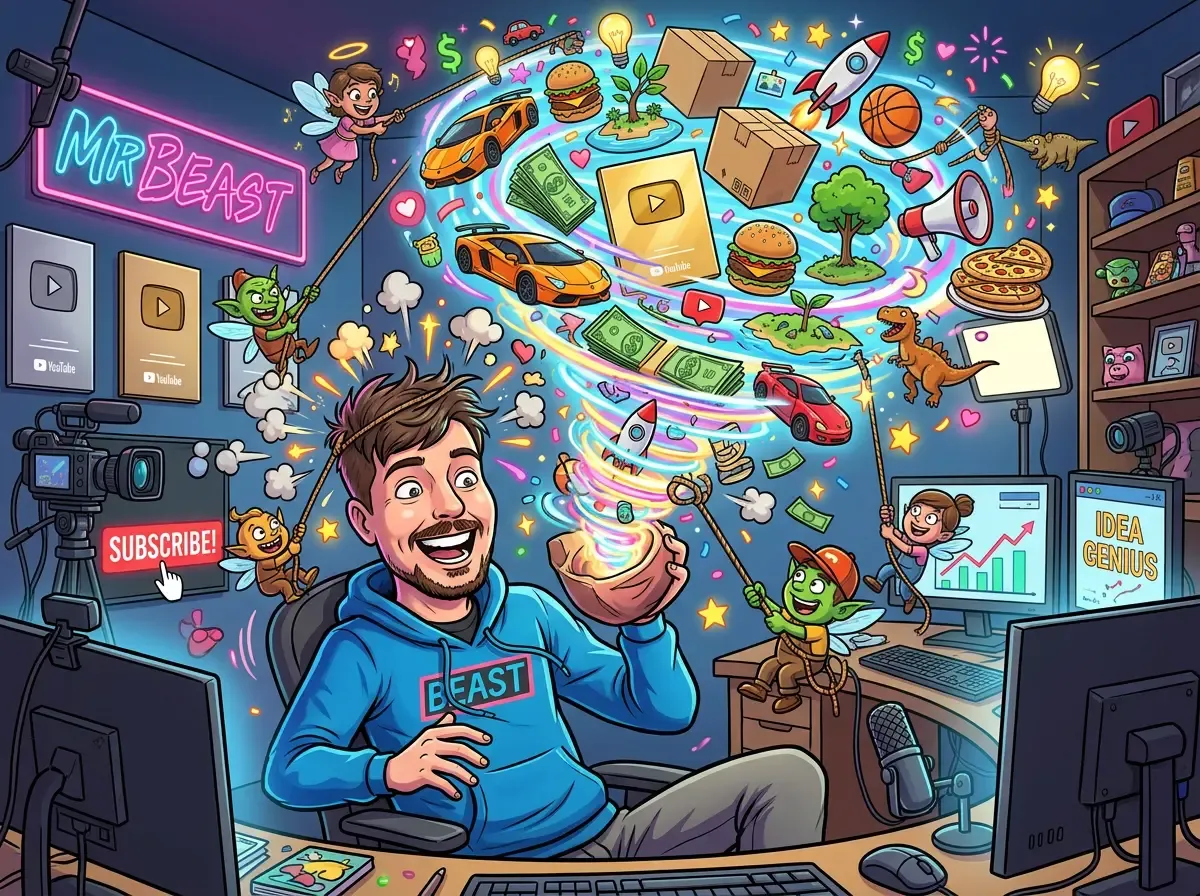
Some of MrBeast’s most-watched early formats needed little more than a camera, a location and a strong idea. Many of the best-performing formats on YouTube, such as challenges, experiments, storytelling and commentary, cost almost nothing to make. Budget isn’t the bottleneck. The idea and the execution are.
What this means for business video
You don’t need to give away cars to use any of this. The same rules apply to a product demo, a client case study or a 30-second Short:
- Lead with the payoff. Show the finished result in the first seconds, then explain how you got there.
- One promise per video. A video that tries to cover your whole service list holds nobody’s attention.
- Cut harder than feels comfortable. Most business videos would be better at half the length.
- Title it like a question someone actually has. “How much does a restaurant website cost?” beats “Our web design services”.
Apply one improvement per video and keep stacking them.
Frequently asked questions
How long should a YouTube title be?
Aim for under 50 characters. Longer titles get cut off with “…” on mobile, and viewers can’t click on what they can’t read. Short, simple and impossible to ignore beats long and descriptive.
Is it better to upload consistently or to upload better videos?
MrBeast’s view is quality over consistency. One exceptional video that gets millions of views builds more audience than a hundred average ones, and a rigid schedule pushes you to publish work you know isn’t your best.
What matters most in the first seconds of a YouTube video?
Confirming the promise of the title and thumbnail. With autoplay, many viewers never consciously see your thumbnail, so the opening seconds have to make them click and keep watching. Echo the promise straight away, then exceed it.
Does this apply to business videos, not just entertainment?
Yes. The principles are about attention, not budget: a clear promise, a strong opening, no dull stretches and staying on topic. They work as well for a product demo or a YouTube Short as for a challenge video.


